AI adoption isn’t slowing, but it is getting focused. The case for a new phase of the hype cycle.
Let me start with the wrong data.
Headline grabbers. The clickbait metrics, picked from a slurry of AI research and reports. Numbers with their own selective bias, pulled by editors for the exact conclusions they draw when presented out of context.
Maybe you saw them in Steve Lohr’s piece for the New York Times last week, titled “Companies Are Pouring Billions Into A.I. It Has Yet to Pay Off.”
-
- 8 in 10.
80%! That’s how many companies investing in AI this year have so far seen “no significant bottom-line impact.” (The author cites McKinsey.)
- 8 in 10.
-
- 42%.
Almost half! A number that “soared” from 17% in 2024! That’s how many organizations report that the majority of their AI pilot projects FAIL and never make it to production. (The author cites S&P Global.)
- 42%.
-
- $61.9B.
That’s so much money! It’s how much money IDC reports businesses are spending on Generative AI this year. A 96% increase YoY, apparently! (No citation given)
- $61.9B.
…Wait a minute. Let’s take a beat.
Here’s a different framing of these same metrics with a less cynical and more nuanced point of view:
-
- 2 in 10 orgs are already seeing bottom-line positive impact, despite only 1% of companies in that same report calling themselves mature enough for AI.
How powerful! And, for what it’s worth, the other report cited in Lohr’s article—from S&P Global—notes that 54% of organizations see “strong positive impact” already in at least one enterprise objective. Funny how these reports work.
- 2 in 10 orgs are already seeing bottom-line positive impact, despite only 1% of companies in that same report calling themselves mature enough for AI.
-
- 58% of companies say the majority of their PoCs are shipping!
That’s an incredible figure, considering the nature of Proofs of Concept. This “42% say the majority of AI PoCs don’t go forward” number—cited by the NYT article—comes from S&P Global. We can’t really figure out what it means or get more details on how the survey was phrased.But here’s another number: In March, IDC also reported that 88% of AI PoCs never go to production. If 42% of respondents state that the majority of their PoCs go into production, that’s incredible!
- 58% of companies say the majority of their PoCs are shipping!
-
- We couldn’t actually figure out where the quoted investment figures from IDC came from, but these estimates range wildly from other sources.
Big numbers! You can find figures in the tens of billions to the hundreds of billions, depending on how the reports distinguish AI investments and what sectors are assessed. Here’s a different, more tempered write up by IDC.
- We couldn’t actually figure out where the quoted investment figures from IDC came from, but these estimates range wildly from other sources.
Lohr’s article, with its 744 comments and countless shares, is part of a budding trend of negatively skewed reporting on AI. Just check the banner image for the article—with the awkward giant AI monster annoying its busy human coworkers—to get the spin.
We get it. AI is disruptive. AI is scary. AI is coming for your lunch (and your job). It’s easy to feel powerless against the wave and thrilling to critique it.
Since the launch of ChatGPT in late 2022, we’ve seen an endless stream of threats to our business-as-usual zen in the public discourse. Everything from graphic reporting on job displacement (Axios), to very real questions about the negative sides of AI (MIT) and Sam Altman posting a Death Star meme before a product launch event (X). Critique away.
But—citing Gartner, as Lohr did—maybe we are just entering an important part of the hype cycle, one that doesn’t indicate a failure of the tech, but the beginning of broader adoption.
See the famed Gartner Hype Cycle below.
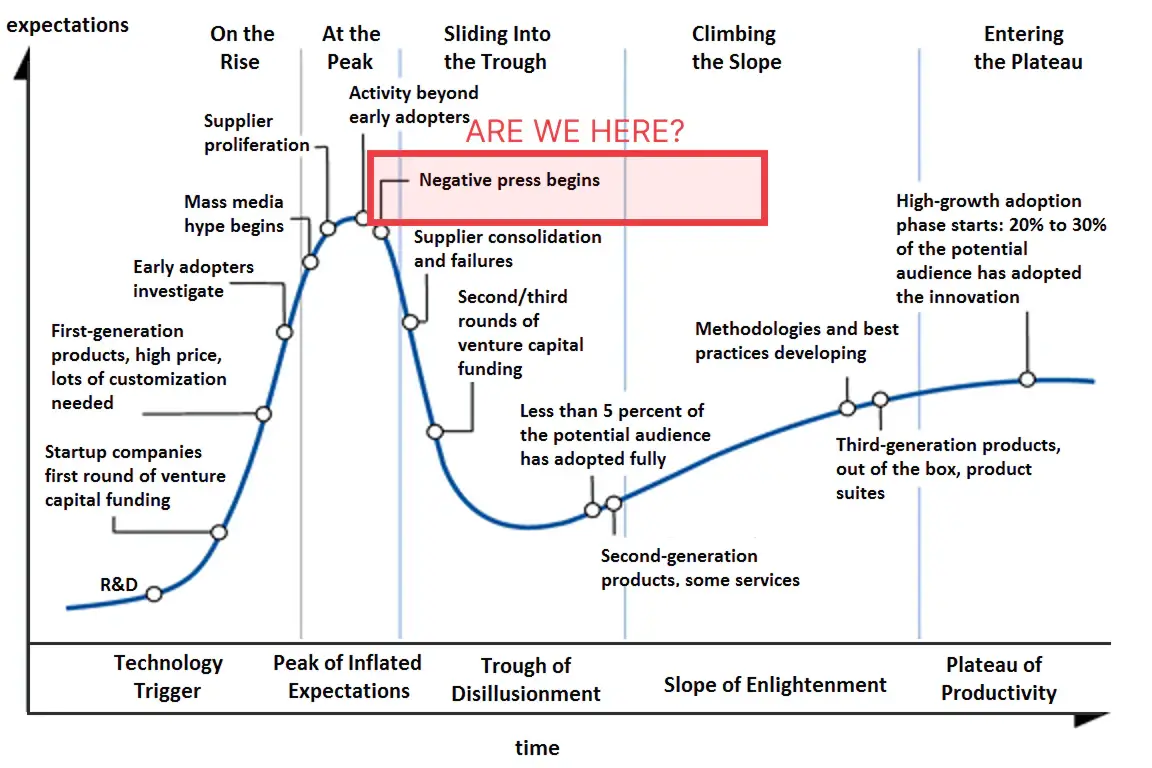
But while it’s a good model for discussion, even the Gartner Hype Cycle gets criticism. It doesn’t always work out this way (not even most of the time) with new tech, and the names can be misleading. And do we really expect AI productivity gains to permanently slope out from here? Do we think expectations have even peaked?
No, we don’t.
It’s not disillusionment time.
It’s time to get to work.
Honestly, we get it. We pick and choose our numbers too—every writer with an angle does. But the fact is, there is so much data around AI right now because everybody senses the value. The figures vary, but the inertia is self-evident. The wow factor is there, and investments are only growing.
The hype is still growing, and it’d be negligent to suggest that we’ve passed the “peak of inflated expectations.” This is world-changing technology. What we’re seeing at Wizeline is an intense, growing interest in building. Our Data Engineering, AI Development, and Cloud Modernization practices have seen high, growing demand over the past two years that’s surprising even us.
Coming into the fall, this trend is only increasing. Our clients are not getting more cautious about the potential of AI; they’re getting more focused and more creative.
Many are moving past tip-toeing in the waters of “Proof of Concept” and want to start solving blockers and scaling production-grade AI. This is a fundamentally better conversation.
We’re not in the trough of disillusionment; companies are just getting to work.
At the heart of Lohr’s piece is the tension between lofty investment figures and the “soaring” numbers of companies “abandoning” AI projects. Shocker—we think it’s a bad spin. So, we think, does JPMorgan CIO Lori Beer, who is cited deeper in the article. Here’s the blurb:
Lori Beer, the global chief information officer at JPMorgan, oversees a worldwide technology staff of 60,000. Has she shut down A.I. projects? Probably hundreds in total, she said. But many of the shelved prototypes, she said, developed concepts and code that were folded into other, continuing projects. “We’re absolutely shutting things down,” Ms. Beer said. “We’re not afraid to shut things down. We don’t think it’s a bad thing. I think it’s a smart thing.”
As confirmed in all studies cited here, the difference-maker is not the tech, it’s the company. The culture, its readiness and willingness to evolve and the market environment in which it plays. Even banks can get it right.
Oftentimes, reframing the approach from building PoCs to building MVPs (where AI viability is explored in real environments with a clear business case behind them) can help. For more on the AI PoC vs. MVP debate and steering smarter AI investments, see our article here.
Yes, we’re biased here too.
There’s no doubt in our minds.
Software engineering is a sort of “main stage” for the AI revolution. As an engineering nearshoring partner, we have skin in that game.
ChatGPT spitting out college essays is one thing, but AI writing fully functional software experiences at speed is something entirely more profound. This prompted reality enables a wider body of creators than ever before to imagine and build.
And that’s world-changing. It’s also great for our business.
We’re talking about a fundamentally futuristic pace of innovation. Efficiency gains? That’s not even half of the value potential.
When AI accelerates engineering speed, it directly leads to a faster clip of business evolution overall – through faster innovation. When you can produce and test faster, you can FAIL faster and iterate towards the right solution faster. That’s driving the cost of failure towards zero.
This, in turn, creates a new flywheel of customer expectation and market fluidity. It also means that enterprises need partners MORE than ever. They not only seek flexible, evolving talent profiles that are culturally consistent, but also foresight to know the hard things about doing the hard things ahead. Experience and complexity awareness. Predictable performance, even if change happens often. Hey, that’s us!
So, how have we been getting to work?
At Wizeline, we’re heavily invested in adoption. Trial and error, with centralized AI leadership.
But we recognize that this transformation won’t come from AI thought leaders alone. AI transformation involves more than just AI, and our approach is an inter-disciplinary one that involves Data, AI, Engineering, Product and Design. Each is responsible for trialing the latest tools, capturing best practices, training peers, and bringing new frameworks to clients.
We see AI creating profound benefits at all levels of engineering, too. There have been questions about whether AI supports junior or senior talent more. We say it makes agile teams faster. Ship more, do more, achieve more. AI elevates junior developers to contribute sooner and frees senior architects to solve more complex, systemic challenges. Both still have a critical place.
We’re sold on AI at Wizeline, both in what we build and how we build it.