One of the world’s largest beverage bottlers puts machine learning to work across business functions, giving field sales, marketing and commercial teams clearer direction in everyday business.
It makes for a more effective, efficient organization with Wizeline as their partners. Our data and machine learning engineers design and operationalize key components of that AI factory, help to automate model production and act as opinionated partners in where the company takes AI next.
AT A GLANCE
- Industry: Consumer packaged goods, beverage bottling and distribution
- Challenge: Keep a mature AI organization producing better models faster, so the people who sell, price and promote get clearer insight into their own work
- Wizeline offering: Embedded data engineering, machine learning, AI and product design teams working inside the client's growth function
- Highlights: About 60 Wizeliners on the account, up from one in January 2025. Feature creation for models cut from weeks to days by an agent the team built. Interactive demos at the company's internal AI showcase.
THE BOTTLER'S AI FACTORY GIVES THEIR PEOPLE A NEW LEVEL OF INFORMED DIRECTION FOR THEIR WORK
Unsurprisingly, a bottling company’s revenue hinges on thousands of small moments. A salesperson in a corner store deciding what to offer, a store owner placing next week’s order, a marketing team choosing when to run a promotion, packaging, placement, all of the nuances of logistics and so much more.
Our client smartly obsesses over these moments. For business to run best, each should be informed by as much intelligent decision making as possible, so they pursued building what its teams call an «AI factory» to make that happen.
Most of what the factory produces is tooling for the bottler’s own internal people and functions.
Examples include guided missions that give field sales a short set of objectives for each store visit, based on what that actual store sells and what it’s likely to need. Or suggested orders that appear in the retailer’s ordering app, calculated from consumption rate and seasonality. Revenue growth management enablers tell marketing and commercial teams when a promotion, a campaign or a price change is likely to pay off. Image recognition capabilities analyze photos of store coolers to confirm products are placed where shoppers will actually see them, and conversational assistants let employees ask questions of company data in plain language.
Every one of these tools comes off the same AI production line. What might be considered the «last stage» of that line is what makes the factory actually improve over time. Each project is mapped to North Star metrics for go-to-market, customer care, growth and performance. Dedicated testing and evaluation teams (the last stage in the line) run A/B tests to start measuring the real return on each AI investment.
Treated as continuous tests, each cycle gives the next intelligence model better evidence to learn from, so the organization’s efficiency compounds instead of resetting with every project.
HOW THE FACTORY WORKS
Feature store. Data engineers curate raw data into data features: the KPIs and data elements a machine learning model can learn from.
Model training. Those features train segmentation, prediction and optimization models.
Exposure. Trained models are made available as APIs and integrated into the sales, ordering and planning applications that call them.
Measurement. Results are tested against business metrics and fed back into the next cycle.
LAYERS OF LEARNING: HOW WIZELINE DATA AND AI/ML ENGINEERS MADE THE FACTORY FASTER AT PRODUCING NEW MODELS
Our client, the bottler, might be thought of as an «advanced AI user.»
They directly employ mathematicians and machine learning specialists who prefer to train models in-house over relying on off-the-shelf libraries, so Wizeline’s data & AI engineers work to that same standard.
Heriberto Perez Peñuelas, our technology director on the account, sorts the models into three families. «Segmentation models [might] classify a customer base into specific tiers like VIP and standard. Prediction models might read trend and seasonality data to forecast the next few months of purchasing behavior. Optimization models simulate real-world scenarios to answer questions around things like fleet size needed to supply a given set of customers in one geography.»
All three of these fundamental models depend on the feature store that enables them, and that’s where our team went deeper into their own R&D.
Alongside delivering products, Wizeline’s engineers set out to build new tools and techniques that improve how the factory produces models. Machine learning still does most of the factory’s work, but modern AI and agents now automate parts of how that machine learning, itself, gets built. Perez Peñuelas calls these «agents that can have [exponential] business impact[, by focusing on machine learning models themselves],» a framing that the business leaders on the client side align with as well.
INSIDE THE R&D: FIVE THINGS THE TEAM BUILT
A feature-creation agent. A «feature» is essentially a curated data element a model learns from, such as how much of each drink brand a store typically sells, or the pricing and promotional structure that informs a new campaign. Raw data becomes first-gen features, which combine into second-gen features. A set of five of these used to take the team weeks to build; the agent does it in days.
Query routing for «talk to your data.» Instead of sending every new question to retrieval-augmented generation (RAG), the assistant first uses language processing to understand what is being asked, then chooses a direct SQL query, a RAG search or another method.
Governed, ontology-based decisions. The team is grounding automated decisions in a governed ontology of the business instead of a generic decision tool, because the bottler’s pricing and supply decisions are business-critical and must always be governed and explainable.
A standard for building models. A framework that fixes how every model is built and documented: its functionality, the libraries it uses and its business logic.
A game that teaches the factory. For the company’s internal AI showcase, the team built a fleet-sizing game in which players deliver a set number of cases within a time limit and balance fleet size against cost. Business staff learn the machine learning behind the predictions; engineers learn the KPIs the business watches.
THE TEAM ACTS AS AN OPINIONATED PARTNER. THAT'S CULTURAL. AND IT'S HOW WIZELINE PUSHED THE BAR.
As the team worked across more and more projects, it began to treat the production line itself as something to improve.
«As we have been involved in all these projects, we have come up with ideas to make this process chain more effective,» said Perez Peñuelas. «We’ve come up with standards and agents that automate part of this production line.»
The model-building framework is the clearest example of this. The team proposed it on its own initiative, drawing on practices Wizeliners had seen work at other companies.
Proposing changes to a sophisticated client’s way of working met resistance at first. «When we started, it was very difficult and resistance was there, but we gained their confidence by just doing great work [consistently in this space],» said Fer Rosas Mercado, Wizeline’s delivery director. Today the client gives the team room to decide how to reach an outcome, and expects it to say so when it sees a better path.
«If I was at a dinner [and wanted to explain how cool this partnership is], that’s really what I would talk about: not all these individual projects, but how we are improving the inner workings of that AI factory.»
That standing extends to how the bottler presents AI to the rest of the company.
At a recent internal AI showcase organized by the data and analytics function and open to the whole organization, Wizeline teams from the AI factory ran interactive demos of fleet sizing, image recognition and conversational assistants. Demos like the fleet-sizing game turn the factory’s R&D into something business staff can try tangibly for themselves.
Wizeline’s leadership team also presents progress on the program, and its view of where the bottler’s AI should go next, to the client’s organization.
KEY TO SUCCESS HERE IS THAT THE TEAM IS SELECTED FOR "STORYTELLING CAPABILITY", AND THEY'VE GROWN FROM ONE ENGINEER TO ABOUT 60
When the bottler first engaged with Wizeline, we worked to give them something beyond technical skill. «They want actual storytellers,» said Rosas Mercado.
As a culture, our client expects every engineer to understand the business epic behind the model or agent they are building, and to explain the work in terms of its business impact. That requirement shapes the team’s mix. Alongside machine learning, generative AI for agents, product design and data engineering, the account depends on what Rosas Mercado calls «super skills»: storytelling, communication and self-management as well as change management as models move from sandbox into production.
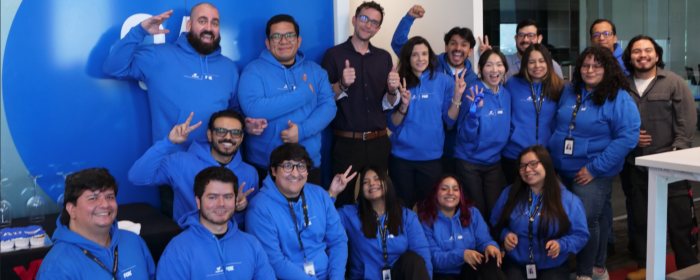
The engagement began with a single Wizeliner and reached 25 people by the end of its first quarter, during an intensive build period. It has since settled into a larger, steady team that works across the factory, from data engineering to the APIs that applications call.
The client’s stakeholders now raise a concern of their own about that team: they want its people to stay, because they consider them hard to replace.
ABOUT 60 WIZELINERS
Embedded in the bottler’s growth function by September 2026, from one engineer in January 2025.
For the past two years, most writing about enterprise AI has focused on getting started: which proofs of concept to run and how to control their cost. Our work with this bottler shows what changes once AI becomes part of daily operations. Its people depend on models every day, so the speed and discipline of the teams that produce those models become a business constraint of their own.
That’s where our team has found its role.
We’ve automated the slowest stage of the bottler’s production line, written standards for how its models are built and documented, explained the work in business terms, and brought the factory’s progress to the rest of the company through demos and leadership presentations. None of it replaced the client’s own expertise. It gave a strong in-house team more capacity and an outside view of how the work could be done, and the bottler now expects us to have a view and argue for it.
We think that is the partnership mature AI organizations need. If yours already runs on AI and wants it to improve with every cycle, look for a partner that will work on the factory as well as its products, and that will tell you plainly when there is a better way to build.
Wizeline embeds data engineering and machine learning teams that build and improve AI systems inside enterprise operations. See Wizeline’s engineering and AI capabilities, or browse more client stories.